
Stainless steel wire is a widely used material in modern manufacturing due to its corrosion resistance, strength, and excellent forming performance. It plays an important role in industries such as filtration, construction, automotive manufacturing, and precision equipment production.
Among various stainless steel materials, 304 stainless steel wire, 304L stainless steel wire, and 316L stainless steel wire are the most commonly used grades in industrial applications.
This article introduces the major applications of stainless steel wire and explains how to choose the right material grade for different industrial environments.
1. Industrial Wire Mesh and Filtration
One of the most common uses of stainless steel wire is in the production of industrial wire mesh and filtration systems.
Typical applications include:
- Industrial filter mesh
- Oil and gas filtration
- Chemical processing filters
- Water treatment screens
- Food processing filtration systems
For most general industrial filtration applications, 304 stainless steel wire offers a good balance between corrosion resistance and cost efficiency.
In more demanding environments such as marine or chemical processing, 316L stainless steel wire is commonly used because of its improved resistance to chloride corrosion.
2. Springs and Mechanical Components
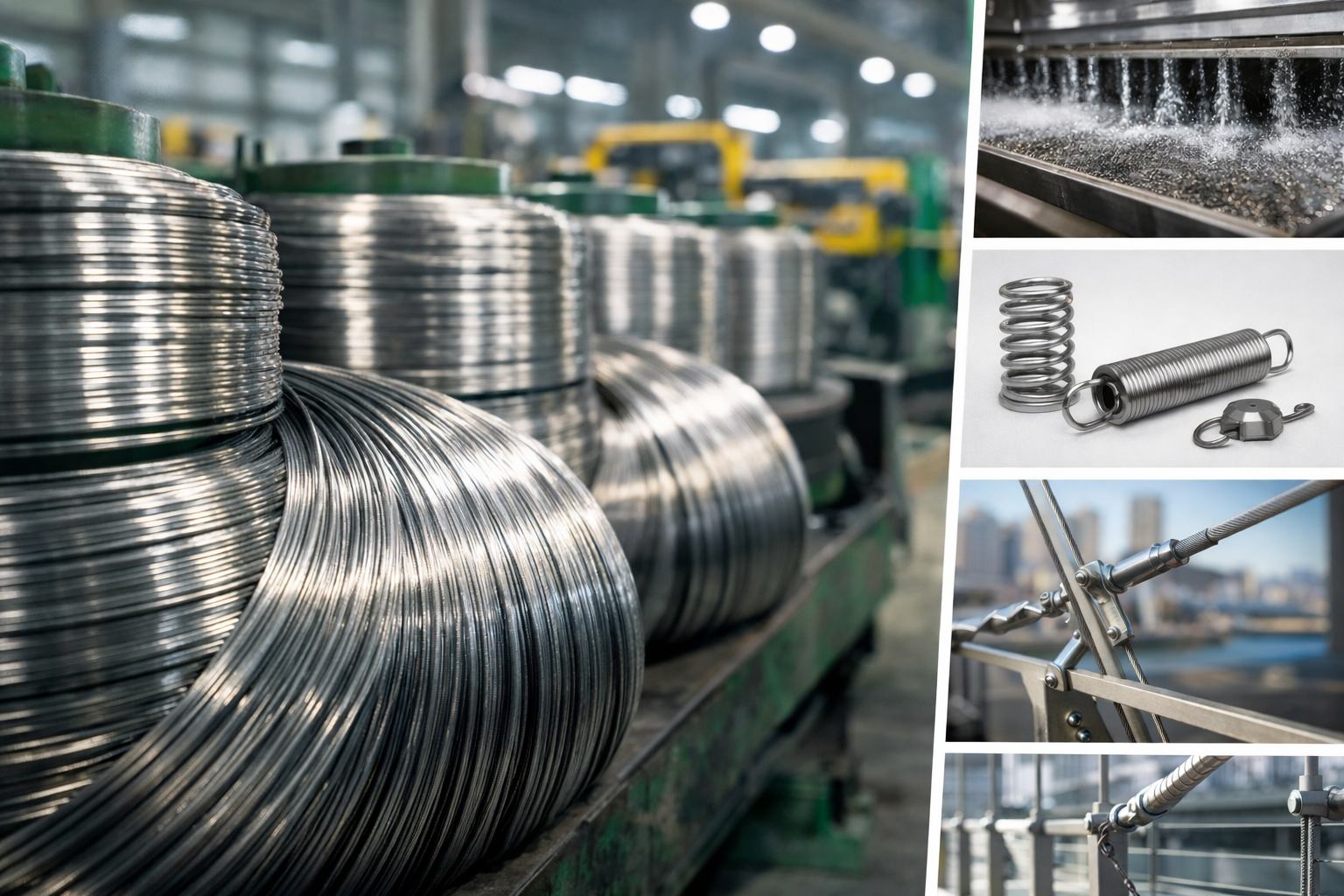
Stainless steel wire is widely used to manufacture springs and mechanical components due to its good elasticity and tensile strength.
Common products include:
- Compression springs
- Extension springs
- Torsion springs
- Industrial fasteners
- Automotive components
These applications require materials with stable mechanical properties and reliable fatigue resistance.
Cold drawn stainless steel wire is often used to achieve higher strength and consistent performance.
3. Stainless Steel Cables and Structural Applications
In construction and infrastructure projects, stainless steel wire is commonly used in cable systems and structural components.
Typical applications include:
- Architectural cable systems
- Safety barriers and guardrails
- Suspension structures
- Decorative architectural mesh
Because of its durability and corrosion resistance, stainless steel wire performs well in both indoor and outdoor environments.
4. Medical and Precision Applications
Certain stainless steel wire materials are used in medical and precision manufacturing industries.
Examples include:
- Surgical instruments
- Orthopedic wires
- Medical guide wires
- Dental devices
For these applications, 316L stainless steel wire is often preferred due to its low carbon content and improved corrosion resistance.
5. Choosing the Right Grade
Selecting the correct stainless steel wire grade depends on the working environment and manufacturing requirements.
Grade |
Main Characteristics |
Typical Applications |
|---|---|---|
| 304 Stainless Steel Wire | Good corrosion resistance, cost-effective | Industrial mesh, springs, hardware |
| 304L Stainless Steel Wire | Lower carbon content, better weldability | Welded components |
| 316L Stainless Steel Wire | Higher corrosion resistance, contains Mo | Marine, chemical, medical applications |
The addition of molybdenum in 316L stainless steel significantly improves resistance to chloride corrosion, making it suitable for aggressive environments.
6. Key Factors When Selecting Stainless Steel Wire
When purchasing stainless steel wire for industrial use, buyers usually consider several factors:
1)Operating Environment
- Exposure to moisture or chemicals
- Marine or chloride environments
- Indoor vs outdoor use
2)Mechanical Requirements
- Tensile strength
- Elasticity
- Fatigue resistance
3)Manufacturing Process
- Cold drawing
- Bending or forming
- Welding requirements
4)Cost Efficiency
Selecting the appropriate stainless steel grade helps manufacturers balance performance, durability, and cost control.
Conclusion
Stainless steel wire is an essential material used in industries such as filtration, automotive manufacturing, construction, and medical equipment production.
Among the commonly used materials, 304 stainless steel wire and 316L stainless steel wire remain the most versatile choices, offering reliable performance across a wide range of industrial applications.
Understanding both the application requirements and material properties helps manufacturers select the most suitable stainless steel wire for their projects.