
Incoloy series alloys are widely used in industrial environments where standard stainless steels may not provide sufficient resistance to heat, oxidation, acid corrosion, chloride attack, or high mechanical stress.
For professional buyers, distributors, and project procurement teams, selecting the right Incoloy grade is not only about choosing a material name. It directly affects equipment service life, fabrication performance, maintenance cost, and long-term project reliability.
This article provides a practical overview of commonly used Incoloy and related nickel alloy grades, including Incoloy 800 / 800H / 800HT, Incoloy 825, Incoloy 926, Incoloy 925, A-286, Alloy 20, Alloy 28, Nickel 200 and Nickel 201. The focus is on industrial applications, product forms, and key purchasing considerations.
What Makes Incoloy Alloys Different from Stainless Steel?
Standard stainless steels such as 304, 316L, 321, 310S, and duplex stainless steels are widely used in many industries. However, when the service environment becomes more demanding, stainless steel may reach its performance limit.
Incoloy and related nickel alloys are often selected when the application involves:
- High-temperature oxidation
- Long-term thermal exposure
- Acidic process media
- Chloride-containing environments
- Seawater or brine service
- Pitting and crevice corrosion risk
- Stress corrosion cracking
- Sour gas or oil and gas service
- High-strength components under corrosive conditions
In general, Incoloy alloys provide a stronger balance of nickel, chromium, iron, molybdenum, copper, titanium, aluminum, or nitrogen, depending on the specific grade. This allows each alloy to perform better in a particular industrial environment.
For buyers, the key point is simple: the correct Incoloy grade should be selected according to the service condition, not only by availability or price.
Key Incoloy Grades for Industrial Buyers
The following table gives a quick comparison of common Incoloy and related nickel alloy grades.
| Grade | Main Strength | Common Product Forms | Typical Industries |
|---|---|---|---|
| Incoloy 800 / 800H / 800HT | High-temperature oxidation and carburization resistance | Plate, sheet, pipe, tube, bar, fittings | Heat treatment, petrochemical, power generation |
| Incoloy 825 | Acid, seawater and chloride corrosion resistance | Plate, sheet, pipe, tube, fittings, flanges | Chemical processing, marine, oil & gas |
| Incoloy 926 | High resistance to pitting and crevice corrosion | Plate, sheet, pipe, tube, bar | Desalination, FGD, seawater systems |
| Incoloy 925 | High strength and corrosion resistance | Bar, forging, fasteners, shafts | Oil & gas, downhole tools, valve components |
| A-286 | High-temperature strength and age-hardening capability | Bar, wire, fasteners, machined parts | Aerospace, turbine, engine, fastener industry |
| Alloy 20 | Sulfuric acid and general chemical corrosion resistance | Plate, sheet, pipe, fittings, valves | Chemical processing, acid equipment |
| Alloy 28 | Chloride and acid corrosion resistance | Plate, pipe, tube, bar, fittings | Oil & gas, phosphoric acid, seawater service |
| Nickel 200 / 201 | Excellent alkali resistance and high nickel purity | Sheet, plate, strip, bar, tube | Caustic soda, chemical, electrical components |
This comparison helps buyers quickly identify which alloy group may be suitable before moving into detailed technical confirmation.
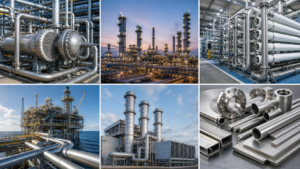
These alloys are commonly used in demanding industrial environments, including chemical processing, marine systems, offshore equipment, power generation and fabricated industrial components.
Incoloy 800 / 800H / 800HT: For High-Temperature Service
Incoloy 800, 800H and 800HT are nickel-iron-chromium alloys mainly used for high-temperature industrial service. They are commonly selected for applications involving oxidation, carburization, thermal exposure and heat-resistant equipment.
| Key Points | Details |
|---|---|
| Main Strength | High-temperature oxidation and carburization resistance |
| Common Applications | Heat exchanger tubes, furnace components, radiant tubes, petrochemical equipment, power generation equipment |
| Common Forms | Plate, sheet, pipe, tube, bar, fittings |
| Selection Note | 800H and 800HT are usually preferred when higher creep or rupture strength is required at elevated temperature |
For procurement, buyers should confirm whether the project requires 800, 800H or 800HT, as the exact grade may affect carbon content, heat treatment, grain size and high-temperature performance.
Incoloy 825: For Acid, Marine and Chemical Processing Environments
Incoloy 825 is a corrosion-resistant nickel-iron-chromium alloy with molybdenum, copper and titanium additions. It is widely used when better resistance to acid corrosion, seawater, brine or chloride stress corrosion cracking is required.
| Key Points | Details |
|---|---|
| Main Strength | Resistance to sulfuric acid, phosphoric acid, seawater and chloride-containing environments |
| Common Applications | Chemical processing equipment, pickling systems, heat exchangers, marine components, offshore equipment, FGD systems |
| Common Forms | Plate, sheet, pipe, tube, fittings, flanges |
| Selection Note | Often considered when 316L stainless steel is not sufficient for the service environment |
For procurement, buyers should provide the corrosive media, concentration, temperature, product form, size, inspection requirements and MTC requirements before quotation.
Incoloy 926: For High-Chloride and Seawater Applications
Incoloy 926 is a highly corrosion-resistant alloy designed for aggressive chloride-containing environments. It is commonly used where resistance to pitting corrosion, crevice corrosion and seawater corrosion is required.
| Key Points | Details |
|---|---|
| Main Strength | High resistance to pitting, crevice corrosion and chloride-related attack |
| Common Applications | Desalination equipment, seawater piping, FGD systems, chemical process tanks, heat exchangers, marine equipment |
| Common Forms | Plate, sheet, pipe, tube, bar |
| Selection Note | Used as an upgraded option when 316L, 317L or some duplex stainless steels cannot meet corrosion requirements |
For procurement, buyers should confirm chloride level, service temperature, pressure condition, welding requirements, inspection requirements and final application environment.
Other Incoloy and Related Nickel Alloy Grades
In addition to 800 series, 825 and 926, there are several other nickel alloy grades frequently discussed in industrial procurement.
| Grade | When to Consider This Grade |
|---|---|
| Incoloy 925 | Use when both high strength and corrosion resistance are required, especially in oil and gas service, downhole tools, shafts, hangers, and valve components. |
| A-286 | Use when high-temperature strength, age-hardening capability, and fastener performance are required, especially for aerospace, turbine, engine and precision components. |
| Alloy 20 | Use when sulfuric acid resistance and general chemical corrosion resistance are required, especially for chemical tanks, pumps, valves and process piping. |
| Alloy 28 | Use when chloride and acid resistance are required in oil and gas, phosphoric acid production, seawater systems and chemical processing. |
| Nickel 200 | Use when high nickel purity, good electrical conductivity and excellent alkali resistance are required. |
| Nickel 201 | Use when similar performance to Nickel 200 is required, but with lower carbon content for higher temperature service. |
These grades should not be selected only by name. In many projects, the final choice depends on the exact service environment, temperature, pressure, corrosion media, and mechanical property requirements.
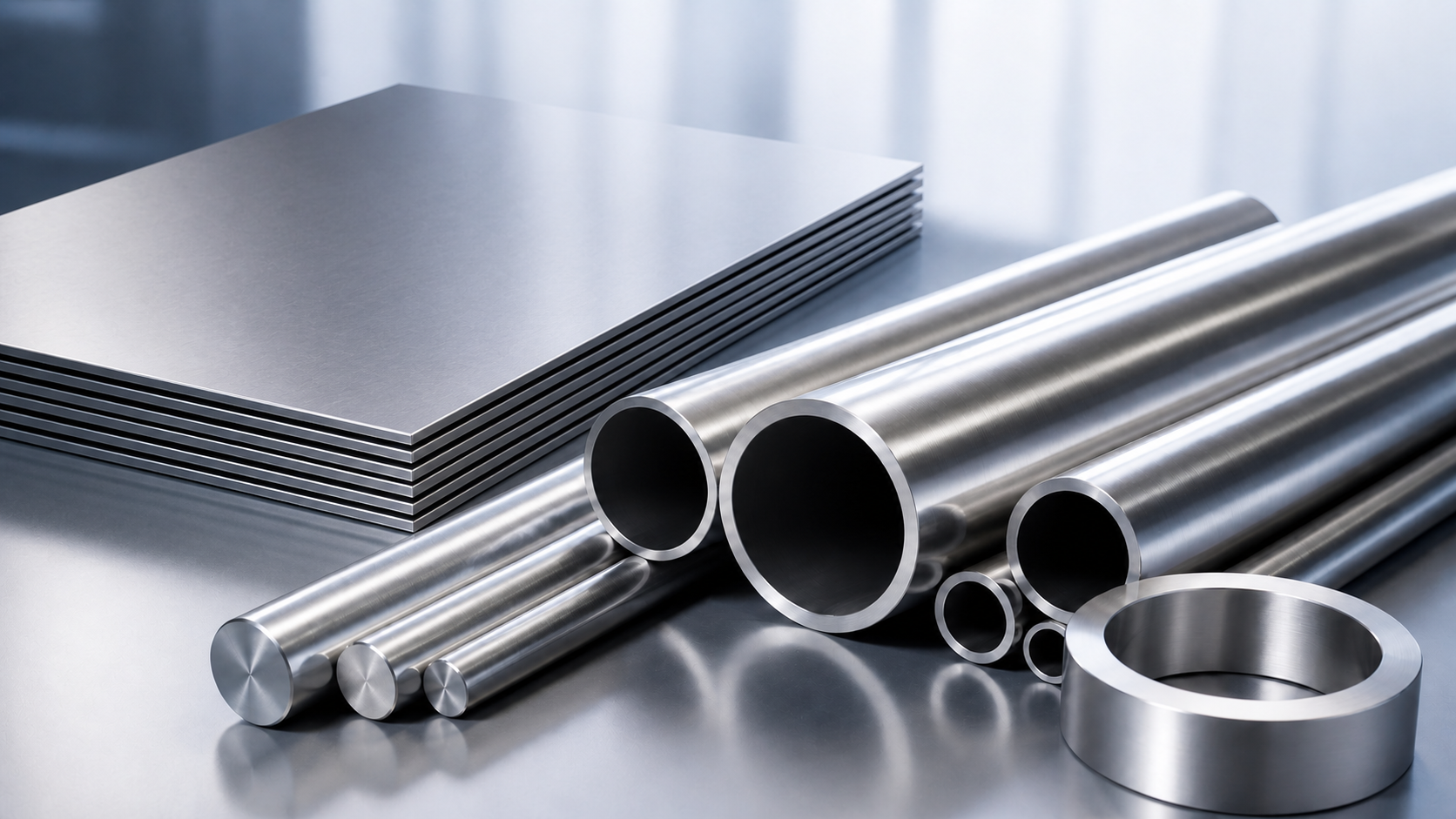
Common Product Forms of Incoloy and Nickel Alloy Materials
Incoloy and related nickel alloy materials are supplied in various product forms depending on the final application, fabrication method and project requirements.
| Product Category | Common Product Forms | Typical Applications |
|---|---|---|
| Flat Products | Plate, sheet, coil, strip, cut-to-size sheet, precision strip | Chemical tanks, pressure vessels, heat exchanger plates, fabricated parts, cladding, industrial components |
| Long Products | Round bar, flat bar, hex bar, forged bar, wire, fastener material | Shafts, bolts, nuts, valve components, machined parts, support components, high-strength industrial parts |
| Tubular Products | Seamless pipe, welded pipe, seamless tube, welded tube, heat exchanger tube, U-bend tube, capillary tube | Heat exchangers, chemical piping, oil and gas systems, seawater systems, power plants, process equipment |
| Flanges and Fittings | Flanges, elbows, tees, reducers, stub ends, caps, custom fittings | Piping systems, pressure equipment, chemical process lines, offshore projects, project-based pipe assemblies |
| Customized Processed Parts | Cut-to-size parts, machined blanks, polished parts, custom length pipe/tube, processed plates | Equipment fabrication, repair projects, OEM components, small-batch industrial procurement |
How to Specify Incoloy Materials Before Quotation
A clear inquiry helps reduce misunderstandings, improve quotation accuracy and shorten sourcing time.
When sending an RFQ for Incoloy or nickel alloy materials, buyers are advised to provide the following information:
| Required Information | Example |
|---|---|
| Grade | Incoloy 825, Incoloy 800H, Incoloy 926 |
| Standard | ASTM B424, ASTM B163, ASTM B423, ASME SB specification, EN standard |
| Product form | Plate, sheet, pipe, tube, bar, flange, fitting |
| Size | Thickness, width, length, OD, wall thickness, diameter |
| Quantity | kg, tons, meters, pieces |
| Surface condition | Pickled, bright annealed, polished, machined |
| Heat treatment condition | Annealed, solution treated, aged, hardened |
| Application | Chemical processing, seawater, furnace, oil and gas |
| Working environment | Temperature, pressure, media, chloride content, acid concentration |
| Inspection | MTC, PMI, UT, PT, hydrostatic test, hardness test |
| Delivery requirement | FOB, CIF, DAP, destination port or delivery address |
For special alloy materials, the application environment is often as important as the grade itself. If the buyer can provide working temperature, corrosive media and end use, the supplier can better check whether the requested grade is suitable.
Quality Documents and Inspection Support
For international B2B orders, quality documentation is an important part of material control.
Depending on the order requirements, Uprime Metal can support the following documents and inspections:
- EN 10204 3.1 Material Test Certificate
- Chemical composition report
- Mechanical property report
- PMI test report
- Ultrasonic test report
- Hydrostatic test report
- Hardness test report
- Dimensional inspection report
- Surface inspection photos
- Packing photos
- Third-party inspection coordination
For project materials, all technical requirements should be confirmed before production or shipment, including grade, standard, size, tolerance, surface condition, heat treatment, testing method and acceptance criteria.
Incoloy Supply Capability from Uprime Metal
Uprime Metal supplies Incoloy and related nickel alloy materials for industrial buyers, distributors, fabricators and project procurement teams.
| Supply Area | Details |
|---|---|
| Grades | Incoloy 800 / 800H / 800HT, 825, 926, 925, A-286, Alloy 20, Alloy 28, Nickel 200 / 201 and other nickel alloys upon request |
| Forms | Plate, sheet, coil, strip, pipe, tube, bar, forgings, flanges, fittings and custom processed parts |
| Processing | Cutting, slitting, shearing, polishing, pipe cutting, custom length processing and surface protection |
| Quality Support | EN 10204 3.1 MTC, inspection reports, PMI, UT, hydrostatic test and third-party inspection coordination |
| Export Service | Export-grade packing, document coordination and international shipment support |
We help buyers source suitable nickel alloy materials with clear specifications, controlled documentation and practical supply support.
Conclusion
The Incoloy series covers a wide range of high-performance alloys for demanding industrial environments. Some grades are mainly used for high-temperature service, while others are selected for acid corrosion resistance, seawater resistance, chloride resistance, or high-strength applications.
For buyers, the most important step is to match the alloy grade with the actual service condition. Price and availability are important, but they should not be the only selection criteria.
Before purchasing Incoloy materials, buyers should confirm the grade, standard, product form, dimensions, quantity, surface condition, heat treatment, inspection requirements and working environment. This helps ensure that the supplied material meets both technical and commercial expectations.