
🔬 Stainless Steel Precision Strip Microstructure: AISI 304 Guide for Forming Applications
📌 Why Microstructure Matters in Stainless Steel Precision Strip
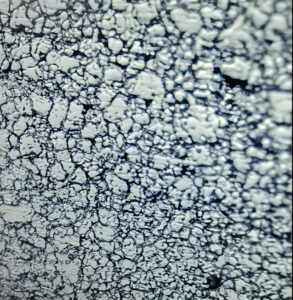
Figure 1. Uniform austenitic grain structure of AISI 304 stainless steel precision strip (solution annealed condition).
When sourcing stainless steel precision strip, buyers often compare:
- Surface finish (BA / 2B)
- Thickness tolerance
- Price
However, in real manufacturing—especially for deep drawing, stamping, and precision forming—the most critical factor is often invisible:
👉 Microstructure consistency
A stable microstructure directly determines:
- Forming performance
- Crack resistance
- Production yield
🔬 What Is the Microstructure of AISI 304 Stainless Steel?
Microstructure refers to the internal grain structure of metal, observed under a microscope after polishing and etching.
For AISI 304 stainless steel precision strip, the ideal microstructure includes:
- Austenitic structure
- Uniform equiaxed grains
- Clear grain boundaries
- No martensite transformation
- No excessive ferrite
This reflects proper control of:
- Cold rolling
- Solution annealing
📊 Why Microstructure Affects Forming Performance
✔ 1. Deep Drawing & Stamping Performance
Uniform grain structure ensures:
- Higher ductility
- Better elongation
- Lower cracking risk
Especially important for:
- Deep drawn parts
- Thin strip stamping
- Complex forming components
✔ 2. Production Stability & Yield
In mass production, instability = cost.
Poor microstructure may cause:
- Edge cracking
- Uneven deformation
- High scrap rate
While good microstructure provides:
- Consistent forming results
- Stable batch performance
- Predictable springback
✔ 3. Hidden Quality Beyond Surface
A good surface (BA / 2B) does not always guarantee internal quality.
Even if material meets standards like:
- ASTM A240
- EN 10088
👉 Poor microstructure can still lead to failure in processing.
📐 Typical Microstructure Requirements for Precision Strip
| Parameter | Typical Requirement |
|---|---|
| Structure | Fully austenitic |
| Grain size | ASTM 7–9 |
| Heat treatment | Solution annealed |
| Uniformity | Across full coil width |
| Defects | No harmful phases |
🔍 How to Check Stainless Steel Microstructure
A standard metallographic inspection includes:
- Sample cutting
- Grinding and polishing
- Chemical etching
- Microscopic observation
Key evaluation points:
- Grain uniformity
- Phase distribution
- Presence of defects
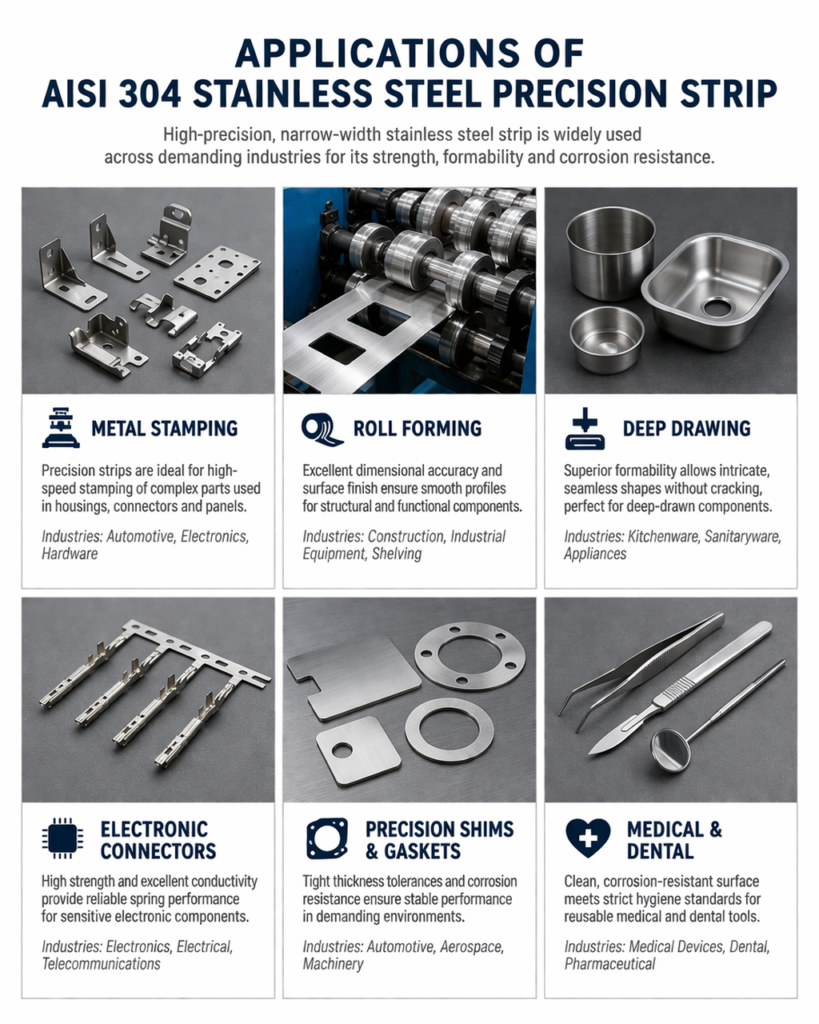
🏭 Applications That Require Strict Microstructure Control
Microstructure is critical in:
- Automotive components
- Electronics hardware
- Kitchen equipment
- Precision springs
- Industrial stamping parts
In these industries, material stability = production efficiency
⚠️ Common Problems Caused by Poor Microstructure
- Cracking during deep drawing
- Inconsistent mechanical properties
- Surface defects after forming
- High rejection rate
These issues often originate from improper annealing or rolling control.
✅ Conclusion
For stainless steel precision strip, microstructure is a key performance indicator—not just a lab result.
While surface finish and price are important, long-term production success depends on:
- Stable grain structure
- Controlled processing
- Consistent quality
👉 Sometimes, the real difference is only visible under a microscope.
📩 Looking for Stable AISI 304 Precision Strip?
We supply:
- BA / 2B stainless steel precision strip
- Tight tolerance control
- Custom slitting
- MTC + PMI + optional metallographic reports
Feel free to share your requirement — we will support your project.
❓ FAQ: Stainless Steel Precision Strip Microstructure
Q1: What is the microstructure of AISI 304 stainless steel?
A: The microstructure of AISI 304 stainless steel is typically austenitic, featuring uniform equiaxed grains and clear grain boundaries.
Q2: Why does microstructure matter in stainless steel precision strip?
A: Because it directly affects ductility, elongation, crack resistance, and forming performance.
Q3: How does microstructure affect deep drawing performance?
A: Uniform grains improve formability, reduce cracking, and stabilize deformation.
Q4: What is the ideal grain size for AISI 304 strip?
A: Typically ASTM grain size 7–9 for balanced strength and ductility.
Q5: Can surface finish guarantee good performance?
A: No. Surface quality does not always reflect internal structure consistency.
Q6: What problems can poor microstructure cause?
A: Cracking, uneven deformation, inconsistent properties, and high scrap rates.
Q7: How can buyers verify microstructure?
A: By requesting metallographic reports showing grain structure and phase distribution.
Q8: Is microstructure important for all applications?
A: It is critical for precision forming, stamping, and deep drawing applications.